Architecture as Memory: How Homes Hold Life and Time
Architecture enters the body before it enters language. This essay explores how light, thresholds, materials and repeated rituals allow a home to hold memory without copying the past.
Jul 18, 2026
Discover the Taste of Architecture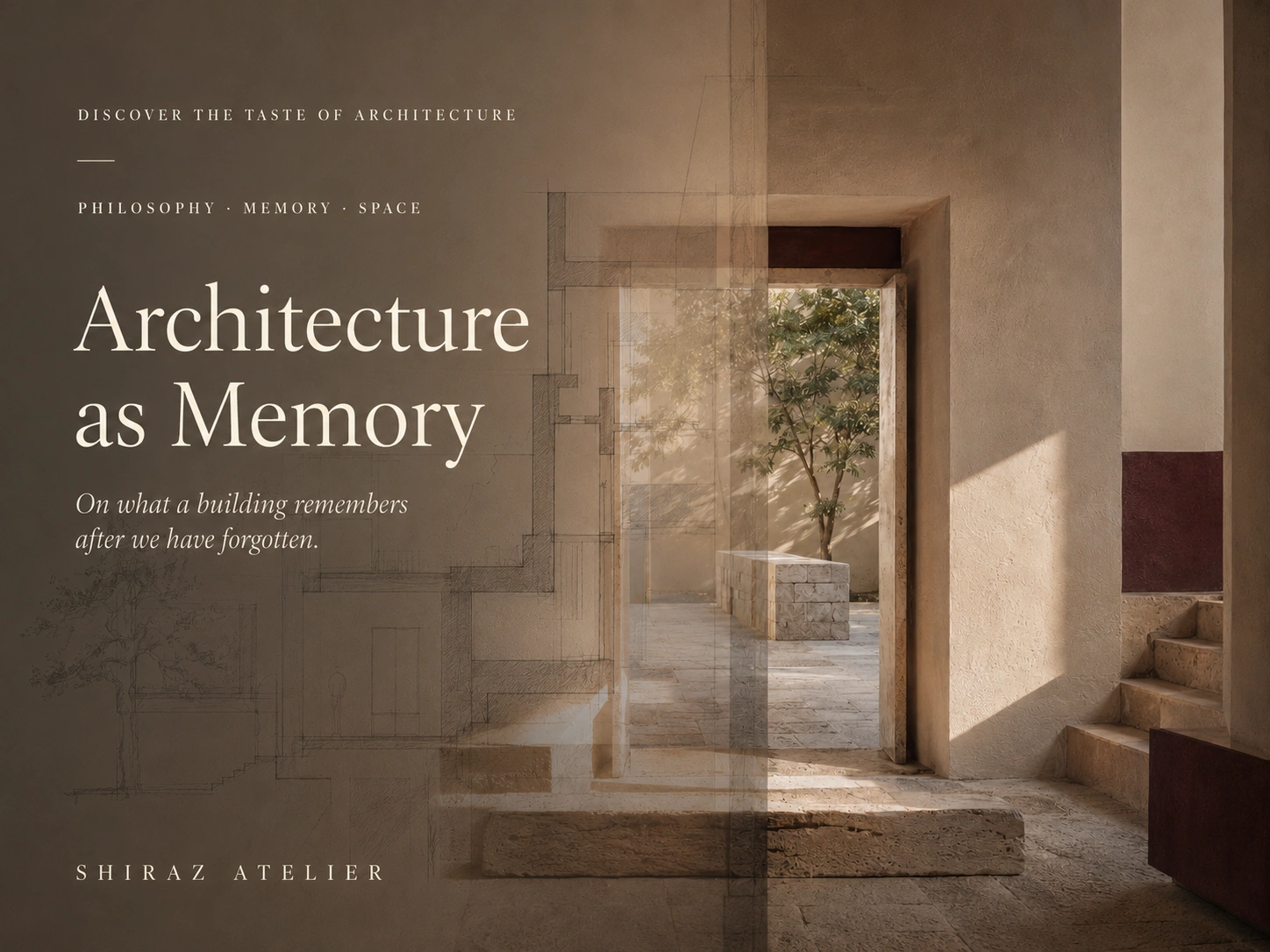
Architecture as Memory
What is architecture as memory?
Architecture as memory is the way a building gives lasting form to lived experience. Light, thresholds, materials, proportions, and repeated rituals enter the body, allowing a place to be remembered even after its plan and appearance have faded.
On what a building remembers after we have forgotten
There are places we remember without being able to describe them.
Not the whole room. Not its dimensions or furniture. What remains may be only the coolness of a tiled floor beneath bare feet, the late sun resting on one wall, or voices arriving from a room we could not yet see.
Memory is rarely an accurate drawing.
It does not preserve space evenly. A window may survive while the wall around it is lost. A stair may remain in the body long after its house has vanished. We remember the weight of a door, the darkness of a corridor before it opened into light, the distance between the kitchen and the garden.
Perhaps this is because architecture enters us before we have words for it.
Long before we understand plan or proportion, we understand near and far, open and enclosed, exposed and protected. We learn the world through rooms, first encountered at the height of a child: beneath a table, beside a window, and at the edge of a doorway.
A building becomes part of memory because it once became part of the body.
What a Place Leaves Behind
We often speak of memory as if it were contained in objects: a photograph, a chair, or a piece of stone carried from one home to another. But spatial memory may be held not in a thing, but in a relationship.
The table was close enough to the kitchen for conversation to continue while food was being prepared. The courtyard could be seen before it could be entered. The bedroom window received the first light. The entrance did not reveal the house at once; arrival unfolded slowly.
These relationships become quiet measures within us. Years later, in an unfamiliar place, we may feel at ease without knowing why. Its light, distance, or sequence has touched an older pattern. The conscious mind has forgotten, but the body recognises it.
The opposite is also true. A room can be generous and functional, yet feel indifferent. Movement has become circulation, windows have become elevations, and rooms have become labeled areas. The building accommodates life without receiving it.
Architecture becomes memorable when it does more than contain an event. It gives the event a form.
A family meal gathers around a certain light. Returning home is marked by a change in sound, temperature, and scale. Architecture does not merely witness these ordinary acts; it helps them become memories.
Memory Is Not Nostalgia
To design with memory is not to reproduce the appearance of the past.
A familiar arch, an old brick, or a traditional roof may awaken associations, but memory is deeper than resemblance. If the underlying way of living has been lost, the copied image becomes a costume. It tells us the past is present while giving us none of its spatial intelligence.
Nostalgia asks, "What did the old house look like?"
Memory asks, "How did it hold life?"
Perhaps its importance was not the pattern on its walls but the shaded distance between interior and street. Perhaps it was not the formal shape of the courtyard but the way several rooms shared its air and watched over it. Perhaps it was not a particular material, but the knowledge that a surface could age without becoming worthless.
These ideas can survive translation. A new home need not imitate an earlier one to continue what mattered within it. A courtyard may become a protected garden room, a deep veranda, or a recessed threshold.
Continuity does not require repetition. The most faithful response to memory may be an unfamiliar form that preserves a familiar relationship.
The House We Carry
Every client arrives with an invisible house.
It is assembled from childhood rooms, homes admired from a distance, places left by necessity, and places never inhabited. Some memories are tender. Others are precisely what a new home must repair.
One person asks for a large window because they remember a dark house. Another asks for privacy because they remember always being visible. Someone wants the kitchen at the centre because food was the language of family. Someone else wants a room at the edge because solitude was difficult to find.
The brief rarely says this directly. It speaks in practical terms: more light, a separate retreat, a view from the kitchen, a protected entrance, a place for everyone to sit. Yet beneath these requests are earlier spaces and the feelings attached to them.
To listen architecturally is to hear both levels.
This does not mean turning design into biography. A building cannot resolve every history. But it can recognise that a request for space is often also a request for a different kind of life.
The architect’s task is not to illustrate the client’s memories. It is to understand what those memories are asking the future to become.
Materials That Remember
Buildings remember in the matter.
Stone holds the weather. Timber darkens where it is touched. Metal records rain and sun. A threshold wears down because thousands of arrivals have crossed it.
These are not necessarily failures. They are traces of participation.
Yet much contemporary construction is asked to resist time. Aging is treated as damage; maintenance promises to erase the evidence that life has occurred.
But a building without the capacity to age has difficulty belonging to time.
The choice of material is also a choice about memory. Will the building conceal use, or register it? Patina is not automatically beautiful, and deterioration is not poetry. But architecture gains dignity when time is treated as a collaborator rather than an enemy.
A house should not be designed only for the photograph taken before anyone moves in. It should be able to receive the marks of occupation and remain whole.
Remembering What Was Already There
Memory does not begin when construction is complete.
Before a building arrives, the site already remembers. It holds patterns of water, wind and sun; perhaps an old tree, a line of movement or a distant view. Even a new block belongs to larger ecological and human histories.
Design can erase these conditions quickly. Land is flattened and a generic object is placed where a particular place once existed.
Or architecture can allow something to continue.
The continuation may be modest: preserving the fall of the ground, framing an existing view, retaining a mature tree, or using shadow and shelter in response to climate. The building need not announce these decisions. Their value may be felt simply as rightness.
To remember a site is not to leave it untouched. All building transforms. The question is whether transformation begins with attention or forgetting.
Rooms for Future Memory
If architecture carries the past, it also prepares the conditions of remembrance.
We cannot design the memories people will form or decide which corner a child will remember decades later. Any attempt to manufacture emotion too precisely becomes sentimental.
But we can give life somewhere to happen.
We can create an edge where someone may pause, a window with depth, a stair to sit upon, or a threshold that slows arrival.
Memory often gathers in these secondary places. Not always in the grand room, but beside it. Not in the feature designed to be photographed, but at the window where light changed every afternoon. The most enduring part of a house may be the part that was never presented as its main idea.
This is why generosity in architecture is not only a matter of area. It is the provision of possibility.
A tightly planned house can still offer places to withdraw and gather, to be alone without being disconnected. Such spaces do not dictate memory. They remain available to it.
Between Remembering and Becoming
Memory can hold us too closely to what has been. Yet families grow and contract, rituals shift, children leave and bodies age. Architecture must receive change.
Architecture must therefore remember without becoming fixed.
Its deepest continuity may lie in adaptation without the loss of identity. A room changes use but keeps its light. A private space becomes shared. The building remains recognisable while learning another life.
The past is not a set of forms waiting to be repeated. It is a source of knowledge about climate, ritual, material, proportion, privacy, gathering and care. When this knowledge is understood rather than copied, it can enter contemporary architecture without losing its depth.
What results may look entirely new.
And yet, somewhere within it, something is recognised.
What the Building Remembers
Eventually, every building outlives the moment of its design.
Drawings are archived. Photographs grow old. Occupants alter rooms, plant trees, move furniture, and leave. The building gathers meanings its architect could not foresee.
This may be architecture’s most humbling quality: once built, it belongs to memory more than to authorship.
What remains is not the purity of the original concept, but the relationship between space and time. A line of morning light. The shelter of an entrance in rain. Footsteps in another room. The view held at the end of a corridor. The place where people always chose to sit.
Architecture is memory not because buildings preserve the past unchanged, but because they allow time to become perceptible.
They receive our repeated lives: this morning at the same window, this return through the same door, this season in the same garden. Passing time acquires edges, surfaces, and light.
And long after the plan has been forgotten, the body remembers the way home.
To see how these ideas can become part of a real design process, read Before the Brief: How Memory Can Inform the Design of a Home.
Discover The Taste Of Architecture
Shiraz Atelier