Canberra Zoning Changes 2026
Canberra’s residential planning rules changed significantly on 1 July 2026. Discover what the new RZ1 and RZ2 provisions mean for dual occupancies, townhouses, low-rise housing, subdivision and the development potential of established suburban blocks.
Jul 29, 2026
Canberra Planning & Building Guides
Canberra Zoning Changes 2026
New RZ1 and RZ2 Rules Explained
In short: On 1 July 2026, Major Plan Amendment 04 expanded the housing types permitted in Canberra’s RZ1 and RZ2 zones. Dual occupancies, terraces, townhouses and qualifying low-rise apartments can now be considered across more established suburbs.
What changed in Canberra on 1 July 2026?
Canberra’s Missing Middle Housing Reform commenced on 1 July 2026 through Major Plan Amendment 04. The amendment changed the ACT Territory Plan to support more low-rise housing in RZ1 and RZ2.
The expanded options include dual occupancies, triplexes, terraces, townhouses, manor houses, qualifying low-rise apartments, cohousing, subdivision and block consolidation.
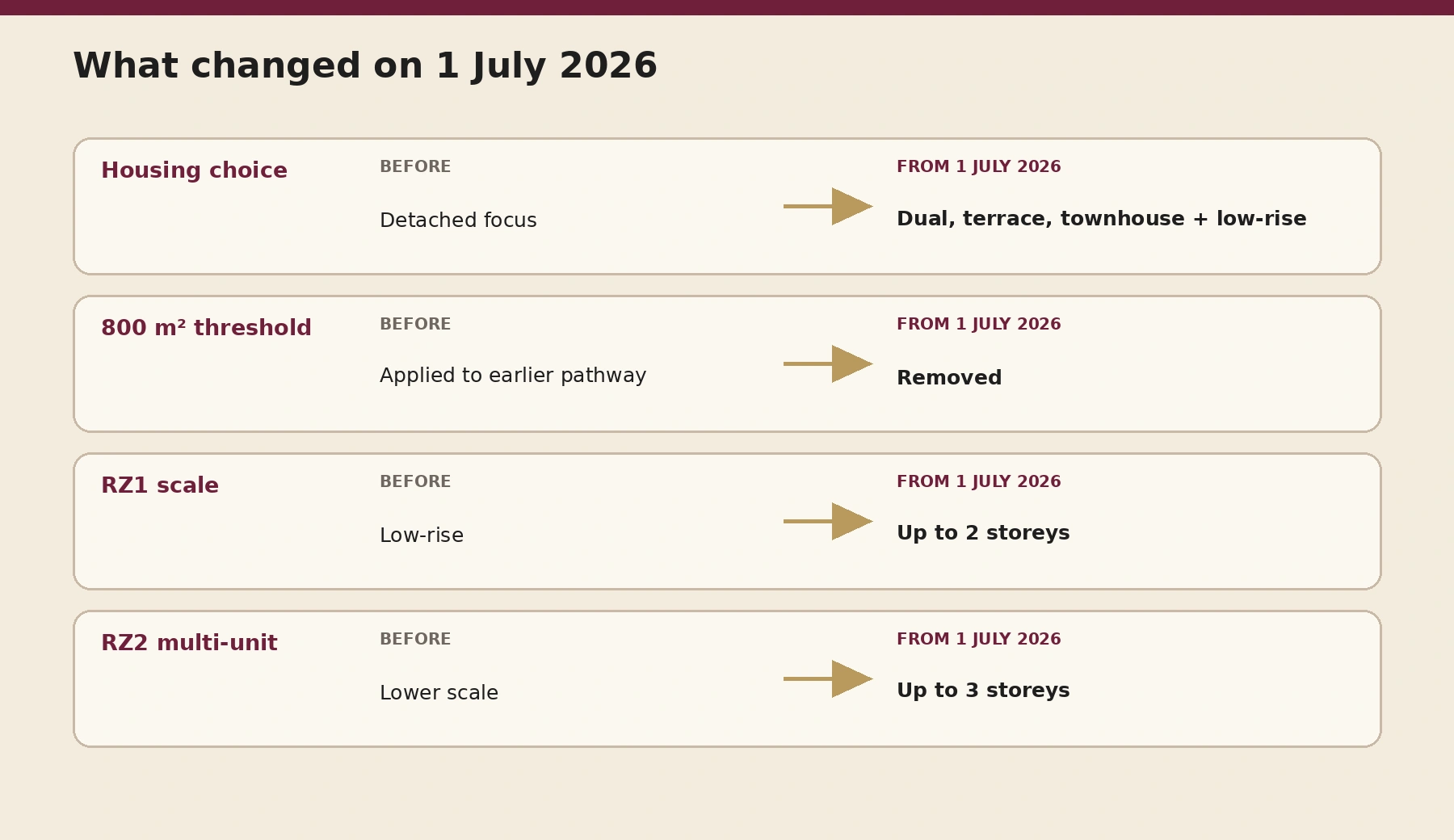
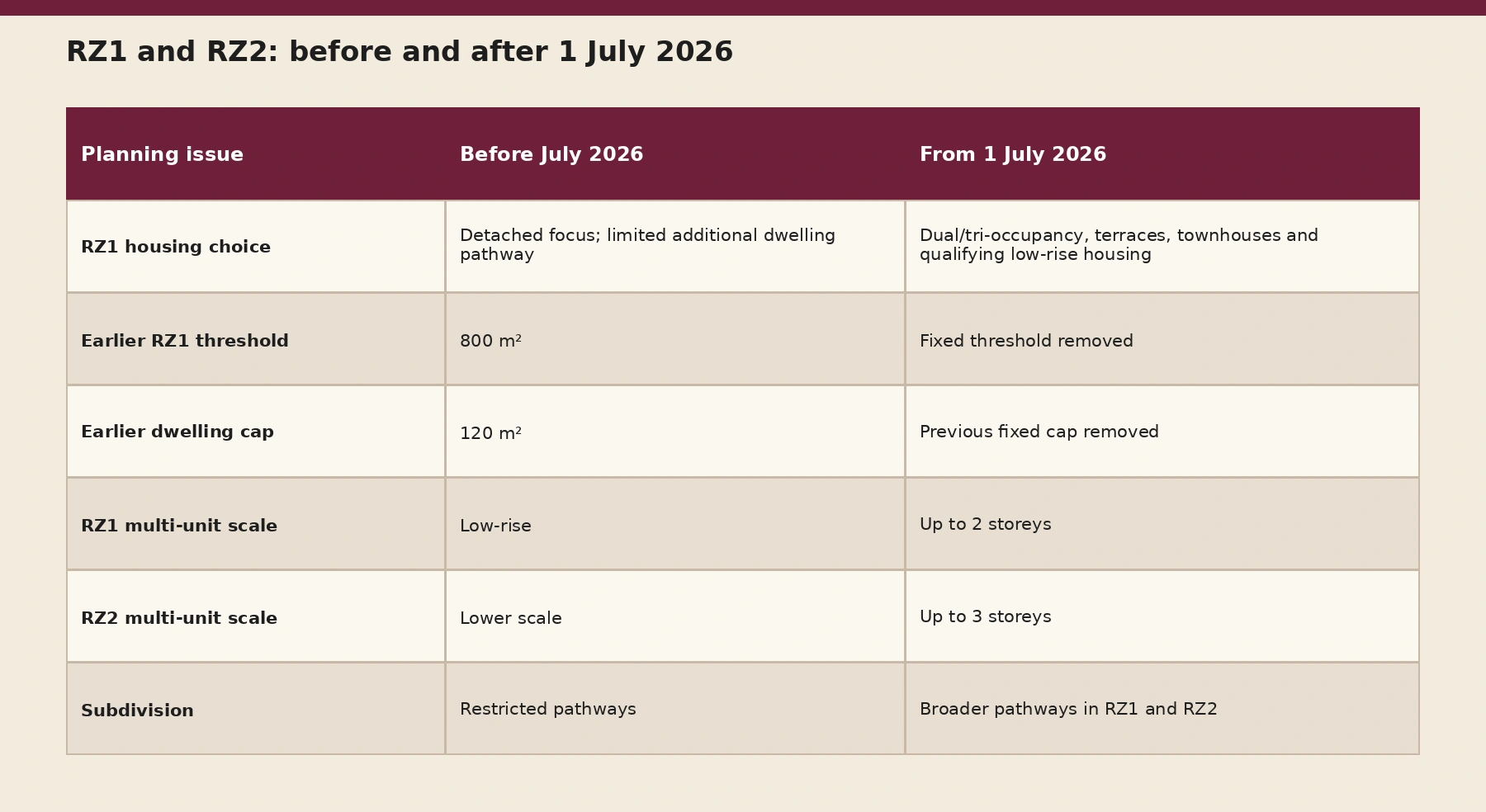
RZ1 development generally remains limited to two storeys, while RZ2 can accommodate multi-unit housing up to three storeys. The change allows these housing types to be proposed; it does not guarantee approval or establish an automatic right to a particular dwelling yield.
What is zoning in Canberra?
Zoning controls how land may be used and what development can be considered. The ACT Territory Plan assigns each block a zone such as RZ1, RZ2 or RZ3.
However, zoning is only one part of Canberra’s system. Most residential land is held under a Crown lease, which may specify the permitted use, maximum number of dwellings and other block-specific restrictions.
A block may therefore be zoned for townhouses while its current Crown lease permits only one dwelling. A lease variation may be required. The Territory Plan establishes planning potential; the Crown lease establishes the block’s current permission.
What do Canberra’s RZ1 to RZ5 zones mean?
RZ1 – Suburban Zone: Canberra’s lowest-density zone, now supporting a broader range of low-rise housing.
RZ2 – Suburban Density Zone: generally close to services and amenities, supporting low- and medium-density housing.
RZ3 – Residential Transition Zone: medium-density, low- to mid-rise housing near services.
RZ4 – Urban Residential Zone: medium- to high-density, mid-rise housing.
RZ5 – Urban Density Zone: higher-density housing in highly accessible locations.
The zone name alone does not determine how many dwellings can be approved. Dimensions, technical controls, site constraints and the Crown lease must also be considered.
Why were the rules changed?
Most residential land in Canberra is RZ1, while comparatively little land is available in higher-density zones. The reform expands housing choice within the existing suburban footprint.
Its aims include more housing diversity, ageing in place, options for downsizers and first-home buyers, multigenerational living, reduced outward expansion and more homes near existing services and transport.
What controls still apply?
Every proposal must still address site coverage, setbacks, private open space, solar access, parking, privacy, tree canopy, planting, permeable surfaces, vehicle access and neighbourhood character.
The Missing Middle Housing Design Guide operates alongside the Territory Plan. Permitting a housing type does not mean every design will be supported: a proposal must demonstrate an appropriate response to its site, neighbours and streetscape.
Does the reform override the Crown lease?
No. The zoning reform changed the Territory Plan, but it did not automatically rewrite every residential Crown lease in Canberra.
Where a lease restricts the block to one dwelling or does not authorise the intended development, a lease variation may still be required. The need for a variation should be established at the beginning of the feasibility process because it can affect timing, cost, public notification and title strategy.
Owners should obtain the current Crown lease rather than relying on a real-estate listing, an old approval or the wording used for a neighbouring property. Two blocks in the same street and zone can have different lease conditions.
Can an RZ1 or RZ2 block be subdivided?
Subdivision can now be considered in both RZ1 and RZ2, but the reform does not guarantee that every multi-unit project can receive separate blocks.
A subdivision proposal must address the Subdivision Technical Specifications, access, services, easements, resulting block dimensions, tree and landscape requirements and any applicable district policy. Some projects may be more suitable for unit titling, particularly where dwellings share a driveway, services or common landscape.
The ownership structure should be tested alongside the architecture. Designing the buildings first and considering titles later can create avoidable redesign, servicing and common-property problems.
What financial measures support missing middle housing?
The ACT Government introduced a time-limited 50% Lease Variation Charge reduction for eligible missing middle developments in RZ1 and RZ2. Published conditions include deferring LVC on or after 10 June 2026, receiving development approval before 30 June 2029 and completing all dwellings by 31 December 2030.
From 1 July 2026, eligible first-home buyers no longer pay conveyance duty, with previous property-value and income thresholds removed. Eligible owner-occupiers purchasing qualifying off-the-plan or turn-key unit-titled homes may also receive a full duty exemption.
These measures can improve feasibility and buyer demand, but they do not remove design, construction, finance, consultant, servicing or approval costs. Eligibility must be confirmed for the particular project and purchaser.
How many dwellings can be built on an RZ1 block?
There is no universal number. Potential yield depends on block size and frontage, coverage, setbacks, open space, tree canopy, parking, slope, orientation, easements, services and lease conditions.
A well-oriented 600 m² block may sometimes support a better outcome than a narrow or constrained 1,000 m² block. Site area alone is not a reliable feasibility test.
The appropriate question is not simply how many dwellings fit. It is how many compliant, comfortable and commercially useful homes can be delivered after circulation, parking, landscape, privacy and construction efficiency are resolved.
Common misunderstandings about the reform
“Permitted” does not mean “automatically approved”. A permitted land use can still be refused if the proposal fails to satisfy assessment requirements or applicable outcomes.
The removal of the 800 m² threshold does not remove site-coverage, canopy, open-space or access controls. Smaller blocks can be assessed, but their constraints may make additional dwellings difficult.
Maximum storeys do not create a guaranteed building envelope. Height, setbacks, solar access and district requirements must be considered together.
Finally, a planning approval for multiple dwellings does not automatically create separate titles. Subdivision or unit titling requires its own coordinated strategy.
Frequently asked questions
Can townhouses now be built in RZ1?
Yes, subject to planning controls, design requirements, site constraints and the Crown lease.
What happened to the 800 m² rule?
The fixed threshold associated with the earlier additional-dwelling pathway was removed on 1 July 2026.
Is RZ1 now the same as RZ2?
No. RZ2 generally supports greater density and multi-unit scale.
Does RZ1 guarantee three dwellings?
No. Approval and yield remain site-specific.
How can I check my zoning?
Search ACTmapi, then review the Crown lease separately.
What should property owners do next?
Before investing in design, assess the Crown lease, site dimensions, slope, orientation, trees, easements, services and likely development yield.
Continue with: Can I Develop My Canberra Block? Crown Leases, Subdivision and Development Potential.
What do these planning changes mean for your property?
Explore your block’s realistic development potential before committing to design. Check My Block’s Potential
Related Shiraz Atelier guides
Continue the Canberra zoning and development series.
Can I Develop My Canberra Block?
Canberra RZ3, RZ4 and RZ5 Zoning Explained
Canberra Commercial and Non-Residential Zoning
Shiraz Atelier provides development potential assessments, feasibility concepts, planning documentation, and architectural design across Canberra.
This article provides general information and does not constitute legal, planning, building-certification, or financial advice. Confirm the current Territory Plan, district policy, Crown lease and approval requirements for the individual property.