Canberra Commercial and Non-Residential Zoning
Planning a commercial development, fit-out or change of use in Canberra? This guide explains commercial, industrial and community zones—and why zoning, Crown lease permissions and NCC building classification must all be checked before proceeding.
Jul 29, 2026
Canberra Planning & Building Guides
Canberra Commercial and Non-Residential Zoning
What Can You Build?
In short: Canberra’s non-residential land includes commercial, industrial, community facility, recreation, transport and non-urban zones. Before buying, leasing or altering a property, check three separate matters: the Territory Plan zone, Crown lease purpose and NCC building classification.
What is a non-residential zone?
A non-residential zone is land primarily intended for business, retail, employment, industry, community facilities, recreation, infrastructure, agriculture or environmental purposes.
The current zone can be checked through ACTmapi. However, zoning alone does not confirm whether a specific business or development can proceed.
Canberra’s CZ1 to CZ6 commercial zones
CZ1 – Core Zone: intensive commercial activity in central areas, including shops, offices, hospitality, entertainment and mixed-use development where permitted.
CZ2 – Business Zone: business and commercial activity around major centres, including offices, professional services, health and retail.
CZ3 – Services Zone: activities requiring vehicle access, loading or larger premises, such as showrooms, service trades and storage.
CZ4 – Local Centre Zone: everyday neighbourhood services such as local shops, cafés, health, offices and community uses.
CZ5 – Mixed Use Zone: combinations of commercial, residential and community activity, often with active ground floors and housing above.
CZ6 – Leisure and Accommodation Zone: entertainment, visitor accommodation and leisure activity.
Industrial zones
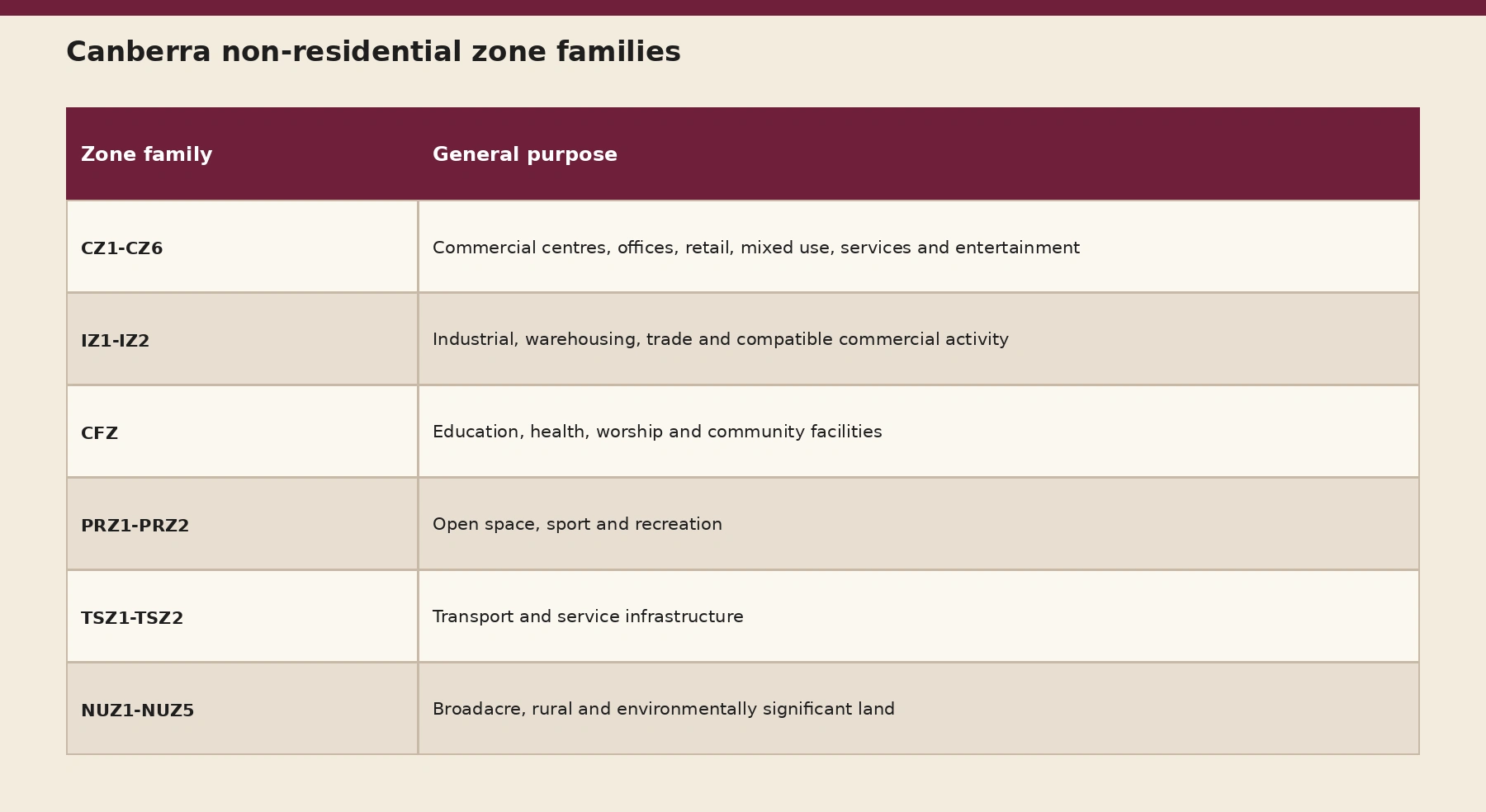
IZ1 – General Industrial Zone supports warehousing, workshops, manufacturing, depots, distribution and trade services. Noise, emissions, heavy vehicles, loading and waste may require assessment.
IZ2 – Mixed Use Industrial Zone supports industrial activity with compatible commercial or service uses, such as workshop plus office, warehouse plus showroom, or production plus sales.
Community, recreation, transport and non-urban zones
CFZ – Community Facility Zone supports education, childcare, health, worship, community, residential care and institutional uses. It is not a general commercial zone.
PRZ1 and PRZ2 cover urban open space and restricted-access recreation. Development must support recreation or open-space purposes.
TSZ1 and TSZ2 support transport corridors and service infrastructure.
NUZ1 to NUZ5 cover broadacre, rural, hills and buffers, river corridors, mountains and bushland. Development is generally more limited and environmentally sensitive.
Three different regulatory questions
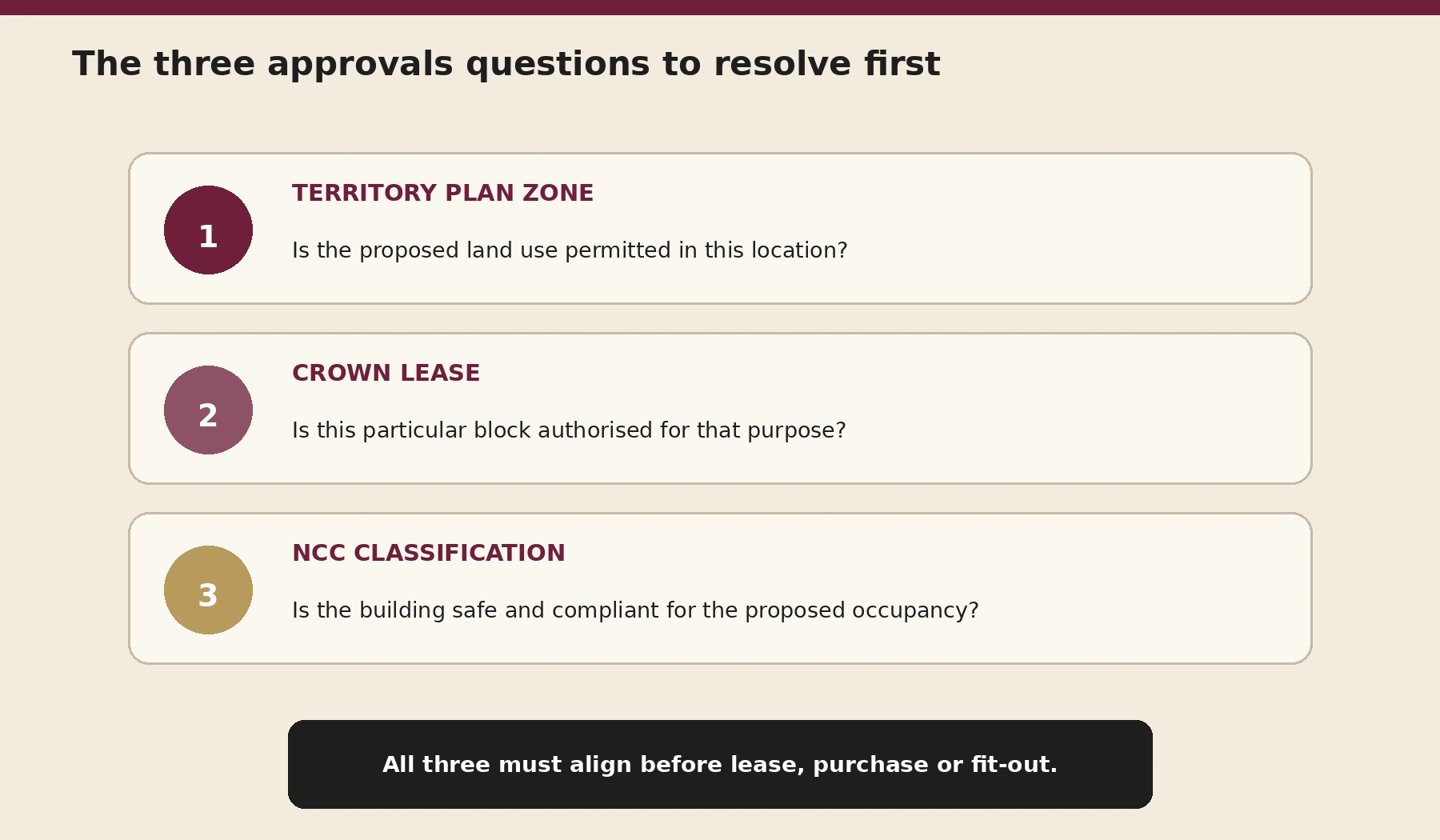
1. Territory Plan zoning — is the proposed land use permitted in that location?
2. Crown lease purpose — is this particular parcel currently authorised for that purpose?
3. NCC building classification — is the building safe and compliant for the proposed occupation?
Common NCC examples include Class 2 apartments, Class 5 offices, Class 6 shops and restaurants, Class 7 warehouses, Class 8 factories, Class 9a healthcare and Class 9b schools or assembly buildings.
Why these three questions must be answered separately
A planning use and an NCC classification describe different things. Planning terminology focuses on how land is used and the impacts of that activity. The NCC focuses on building safety and construction requirements for the people occupying it.
The Crown lease adds a property-specific layer. A use may be allowed in the zone and technically possible under the NCC, yet still require a lease variation because the existing lease purpose is narrower.
Treating one approval as evidence of the others is risky. A lease clause does not prove that a building satisfies current fire and access requirements, and a building approval does not necessarily authorise a new planning use.
What is a change of use?
A change of use occurs when land or a building begins operating for a purpose different from its existing approved use. Examples include office to training centre, residence to medical practice, warehouse to gym, shop to restaurant or office to childcare.
Changing only the tenant or business name is not necessarily a change of use. The key question is whether the planning use, intensity or building classification changes.
Does a change of use require a DA?
It may. A DA can be required where the use differs from the approval, the lease does not permit it, external work is proposed, impacts change, or an exempt pathway is not available.
Even where no planning DA is required, building approval may be necessary for alterations or a change of classification. Approval requirements should be confirmed before signing a lease.
DA, building approval and occupancy are different stages
A development application considers planning matters such as land use, external design, traffic, parking, noise, servicing and impacts on surrounding properties.
A building approval considers whether the proposed construction complies with the Building Act, NCC and relevant technical standards. The certifier may require architectural drawings and advice from fire, access, structural and building-services consultants.
Before occupation, completion and occupancy requirements must also be satisfied. A tenant should not assume that receiving planning approval means the premises can immediately operate.
What upgrades can be triggered?
A new use may introduce more occupants, different fire risks or accessibility duties. Possible upgrades include exits, fire-isolated stairs, emergency lighting, alarms, fire-rated construction, accessible paths and toilets, hearing augmentation, ventilation, exhaust, additional amenities, structure and acoustics.
Changing an office from Class 5 to Class 9b education or assembly can significantly alter fire-safety, egress, accessibility and occupant-capacity requirements.
Can residential development occur in commercial zones?
Residential or mixed-use development may be possible in some commercial zones, particularly where the Territory Plan and district policy support housing.
A typical mixed-use building may place shops, hospitality, offices or community uses at ground level with apartments above. The design must resolve separate access, fire separation, acoustic privacy, servicing, loading, waste, ventilation and the interface between residents and late-night activity.
Housing should not undermine the intended commercial function of a centre. Active frontage and adequate commercial floor space may remain important even where residential development is permitted.
A practical pre-lease assessment
Before committing to a commercial tenancy, prepare a concise assessment of the proposed use, zone, Crown lease, existing approvals and building classification.
Inspect the premises for entry accessibility, sanitary facilities, exits, fire systems, ceiling height, structure, ventilation, electrical capacity, kitchen exhaust potential, waste access and signage opportunities.
The assessment should identify required consultants, likely approval pathways, major upgrade risks and whether the proposed fit-out can be delivered within the tenant’s budget and program. This is particularly important for education, childcare, health, hospitality, assembly and high-occupancy uses.
Before leasing or buying
Check zoning, district policy, Crown lease, existing approved use, building classification, DA or lease variation needs, fire and access upgrades, parking, loading, waste, heritage, signage and likely costs.
A property may appear suitable but become unviable once fire, access, parking or lease requirements are understood.
Frequently asked questions
Can any business operate on commercially zoned land?
No. Zone policy and the Crown lease both matter.
Can an office become a school?
Potentially, with possible change-of-use, lease, building and Class 9b requirements.
Can a warehouse become a gym?
Potentially, but parking, fire, access, ventilation and occupancy may change.
Does a new tenant require a DA?
Not always, if the approved use and intensity remain unchanged.
Does zoning approval mean the building complies?
No. Planning and building compliance are separate.
What do these planning changes mean for your property?
Explore your block’s realistic development potential before committing to design. Check My Block’s Potential
Related Shiraz Atelier guides
Continue the Canberra zoning and development series.
Canberra Zoning Changes 2026: RZ1 and RZ2
Can I Develop My Canberra Block?
Canberra RZ3, RZ4 and RZ5 Zoning Explained
Shiraz Atelier provides development-potential assessments, feasibility concepts, planning documentation and architectural design across Canberra.
This article provides general information and does not constitute legal, planning, building-certification or financial advice. Confirm the current Territory Plan, district policy, Crown lease and approval requirements for the individual property.