NCC 2025 Volume One: What Changes for Commercial Buildings

One of the most significant commercial building code reforms in a decade — what it requires, what it costs and what it means for projects in the ACT
NCC 2025 was released on 1 May 2026. In the ACT, NCC 2025 commences immediately, with a transition window: projects may elect either NCC 2022 or NCC 2025 for Building Approvals between 1 May 2026 and 1 May 2027. This is a voluntary adoption window, not a mandatory switch. Projects with a DA lodged before 1 November 2026 may continue under NCC 2022 until that DA expires. Projects unlikely to achieve Building Approval by 1 May 2027 should be designed to NCC 2025 now to avoid redesign under approval pressure.
NCC 2025 Volume One introduces one of the most substantial commercial energy efficiency reforms in Australian building code history — on-site solar PV now required under the DTS pathway for all new commercial buildings, a greenhouse gas emissions cap alongside the existing energy cap, strengthened condensation management, overhauled water management requirements and enhanced carpark fire safety. For designers, developers and building owners in the ACT, understanding these changes before a DA is lodged is the difference between a project that complies and one that requires expensive redesign under certification pressure.
The 2025 edition of the National Construction Code was published on 1 May 2026, following a preview period beginning in February 2026. NCC 2025 is primarily a commercial building reform — one of the most consequential updates to Volume One since NCC 2019 established the current energy efficiency framework.
For residential buildings (Volume Two), the changes are more targeted, and in several significant areas, previously proposed changes were withdrawn—a deliberate decision by building ministers to provide regulatory stability for the housing sector until at least mid-2029.
This essay covers Volume One—commercial buildings, Classes 3 and 5 through 9, with a note on the specific split-code situation for mixed-use buildings containing Class 2 apartments. A separate essay addresses Volume Two residential implications.
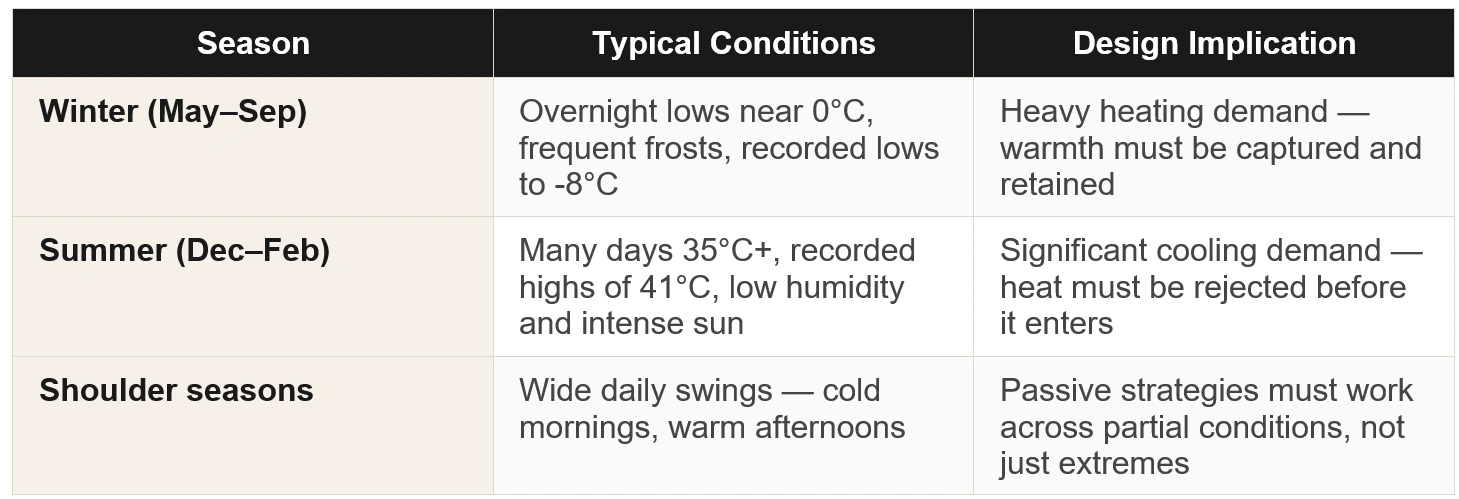
The ACT Adoption Position
The ACT government has confirmed adoption of NCC 2025 from 1 May 2026. An important distinction: this is the commencement date, not a mandatory switch date. Between 1 May 2026 and 1 May 2027, both NCC 2022 and NCC 2025 are available for use, but a project must nominate one version and cannot mix provisions between editions.
The ACT government has confirmed a variation exempting existing buildings seeking building approvals from the new NCC 2025 waterproofing provisions — a practical relief for heritage and existing building work. This variation does not apply to new commercial buildings or new apartment developments..
Important Note: Class 2 Apartments in Mixed-Use Buildings
A split-code situation — one building, two energy regimes
NCC 2025 does not apply the new Section J commercial energy provisions to Class 2 apartment buildings. Class 2 remains under NCC 2022 Amendment 2 for energy efficiency. This seems straightforward for pure residential projects — but for mixed-use commercial developments in the ACT, it creates a split-code situation that requires careful documentation.
A building containing ground floor retail (Class 6) and apartments above (Class 2) must comply with two different energy regimes simultaneously. The retail component is subject to the NCC 2025 Section J requirements — including the GHG emissions cap and the solar PV provisions. The residential apartments above are assessed against NCC 2022 Amendment 2 energy requirements. The PV system required for the commercial podium cannot be credited against the residential energy performance.
For ACT developers planning mixed-use projects, this split requires explicit identification of which floors or areas are subject to which code provisions in both the design documentation and the energy compliance report. Engage your energy assessor and certifier early on any mixed-use project to confirm how the two regimes are separated and documented.
Change 1: On-Site Solar PV Now Required Under DTS (Section J — J9D5)
This is the most significant single change in NCC 2025 and the one with the greatest impact on commercial building design, documentation and cost.
J9D5 On-Site Solar Photovoltaic Systems — Required Under DTS
What changed: NCC 2022 required only solar-ready provisions — reserved roof space and conduit rough-in. NCC 2025 requires installed solar PV systems on all new commercial buildings (Class 3, 5–9) under the DTS pathway. The DTS pathway provides two compliance options: Option A — PV array covering the available roof area (net of exclusions including trafficable zones, plant areas, surfaces shaded for more than 10% of daylight hours, and other specified exclusions); or Option B — a minimum installed output per m² of conditioned floor area based on building class and climate zone. Practitioners select whichever option results in the smaller system size for their specific project. For gas-using buildings, Table J9D5b requires additional PV capacity to offset greenhouse gas emissions from those gas appliances.
Design impact: Solar PV is now a design decision beginning at schematic design, not a services specification resolved in documentation. The two compliance pathways have different implications for different building types — taller buildings with smaller roof-to-floor ratios may find Option B (output per m² of conditioned area) produces a smaller system requirement than Option A. In most mid-rise commercial buildings, Option A is the practical path and requires systematic roof planning. Mechanical plant, cooling towers, exhaust risers and BMU access compete with PV panels for roof space. For gas-powered buildings, the Table J9D5b offset requirement often makes all-electric services the lower-cost compliance pathway — not because gas is prohibited, but because the additional PV required to offset gas emissions frequently exceeds available roof space after Option A is satisfied.
ACT note: ACT commercial projects with BA after 1 May 2027 must comply. Projects in the transition window (BA before 1 May 2027) can elect NCC 2022. For Green Star projects, the mandatory PV baseline under NCC 2025 means rooftop solar is no longer available as a differentiation strategy between the proposed and reference buildings under current Green Star methodology — envelope performance, HVAC efficiency and lighting become the primary levers.
What This Means for Roof Design
• Plant rooms, cooling towers and HVAC equipment should be positioned to minimise roof shading — or located within the building envelope to free roof space
• BMU tracks and access routes must be coordinated with PV panel layouts from schematic design
• Skylights and roof penetrations must be coordinated with PV coverage requirements
• The gas offset clause in Table J9D5b effectively makes all-electric the lowest-cost DTS path for most commercial buildings in the ACT — where the grid emission factor is already low due to renewable purchase agreements
• Structural loads must account for PV panel weight distribution across the roof structure
• Option A vs Option B should be assessed for each project — the smaller resulting system size is the compliant choice
Change 2: Greenhouse Gas Emissions — New Performance Requirement (J1P1)
J1P1 Near-Zero Operational Greenhouse Gas Emissions — Performance Requirement
What changed: NCC 2025 introduces a greenhouse gas emissions consideration into the commercial energy Performance Requirement J1P1, alongside the existing energy consumption cap. The Performance Requirement now references near-zero operational greenhouse gas emissions as an objective. The DTS pathway introduces emissions-based compliance alongside energy consumption limits. Electricity grid emission factors in NCC 2025 have been significantly updated to reflect the grid's increasing renewable content — ACT electricity emission factors drop substantially from NCC 2022 values, reflecting the ACT's renewable electricity purchase agreements.
Design impact: The emissions consideration changes the compliance calculation for buildings with gas appliances. A building that met its energy cap under NCC 2022 through gas-intensive systems may not achieve the combined energy and emissions performance under NCC 2025. The ACT grid's high renewable content means the emissions factor for electricity is very low in NCC 2025 modelling — making all-electric services the most straightforward compliance path in the ACT. Engage your energy assessor early to model both energy and emissions compliance for any project with gas services.
ACT note: The ACT grid's renewable purchase agreements are reflected in substantially reduced electricity emission factors in NCC 2025 energy modelling. For ACT commercial projects, this makes all-electric compliance easier to demonstrate and gas compliance harder — the combination of reduced grid emission factors and the J9D5b gas offset PV requirement creates a strong economic and compliance case for electrification.

Change 3: Commercial Energy Efficiency — Section J Stringency
Beyond the solar PV requirement, NCC 2025 increases the stringency of Section J provisions across building envelope, HVAC, lighting and ventilation for Class 3 and Class 5–9 buildings.
Change 4: Water Management — Volume One Section F
Section F Restructured Water Management Provisions
What changed: NCC 2025 Volume One Section F undergoes a full restructure of Performance Requirements for water management, with new defined terms that change the scope of coverage. New DTS provisions address waterproofing of balconies, wet areas and below-ground construction. A key change under the DTS pathway: waterproofing membranes must be applied to the structural concrete substrate without a screed, topping or levelling compound between the substrate and the membrane. Floor substrates must achieve the specified falls (typically 1:80 minimum) in the structural concrete before membrane application. Note: where a structural slab cannot achieve the required falls, a Performance Solution engaging a suitably qualified consultant remains available as an alternative pathway.
Design impact: The membrane-to-substrate requirement is the most significant site-level risk in NCC 2025. Falls must be designed into the structural formwork — not corrected afterwards with a screed under the DTS pathway. This changes the documentation requirement: structural drawings must specify slab falls with the tolerance precision required to achieve compliant profiles in the poured concrete. Where concrete placement cannot achieve compliant falls, the Performance Solution pathway provides an exit — but it requires consultant documentation and certifier agreement, which adds cost and time. Address this in the structural documentation stage, not on site.
ACT note: The ACT government has confirmed a variation exempting existing buildings seeking building approvals from the new waterproofing requirements. This applies to fitout and alteration work in existing commercial buildings. New commercial buildings and new apartment developments are subject to the full NCC 2025 requirements.
Change 5: Carpark Fire Safety
Section C / E Enhanced Fire Safety Requirements for Carparks
What changed: NCC 2025 strengthens fire safety requirements for carparks, including: sprinkler protection now required for open-deck carparks other than stand-alone open-deck carparks; reduced scenarios where concessions to fire-resistance levels (FRL) apply; and clarification in AS 2118.6 that plastic pipe cannot be used above ground in combined sprinkler and hydrant systems. The carpark fire safety changes respond primarily to increased vehicle sizes reducing natural ventilation effectiveness and the increased use of mechanical stacking systems — not to EV-specific fire loads.
Design impact: Open-deck carparks that qualified for unsprinklered concessions under NCC 2022 may now require sprinkler systems under NCC 2025 — with the exception of stand-alone open-deck carparks. Mixed-use podium developments and basement carparks attached to commercial or apartment buildings are most affected. The trade-off: sprinklered carparks may qualify for reduced FRL requirements on structural elements, potentially offsetting some of the sprinkler installation cost through lighter concrete and steel specifications. Early coordination between fire engineer and structural engineer is required to assess whether the FRL offset is achievable and cost-beneficial for the specific project.
ACT note: Commercial and mixed-use ACT developments with basement or podium carparks should assess the sprinkler requirement impact at concept design. The FRL trade-off opportunity requires coordination at schematic stage — not in documentation.
Change 6: All-Gender Sanitary Facilities and Amenities
Part F4 All-Gender Facilities and Increased Female Toilet Ratios
What changed: NCC 2025 introduces a voluntary pathway for all-gender sanitary facilities alongside separate male and female facilities, applicable to commercial buildings. Up to 50% of required male and female facilities may be provided as all-gender facilities where the building or tenancy has higher occupancy levels — a higher proportion may apply for lower-occupancy applications. Mandatory sanitary product dispensers are required in new commercial and public buildings. Female toilet ratios are increased.
Design impact: The voluntary all-gender pathway offers planning flexibility for commercial fitouts — particularly in lower-occupancy tenancies where separate facilities are disproportionately space-intensive. The increased female toilet ratio affects the total facility count and spatial allocation for retail, education and assembly occupancies. Confirm the applicable ratio for your specific building class and occupancy with your certifier.
ACT note: The voluntary all-gender pathway is a practical option for ACT commercial fitouts where spatial efficiency matters. The increased female toilet ratios should be incorporated into toilet core planning for any new commercial building or significant tenancy fitout in the ACT from 1 May 2026.

What NCC 2025 Does NOT Change for Commercial Buildings
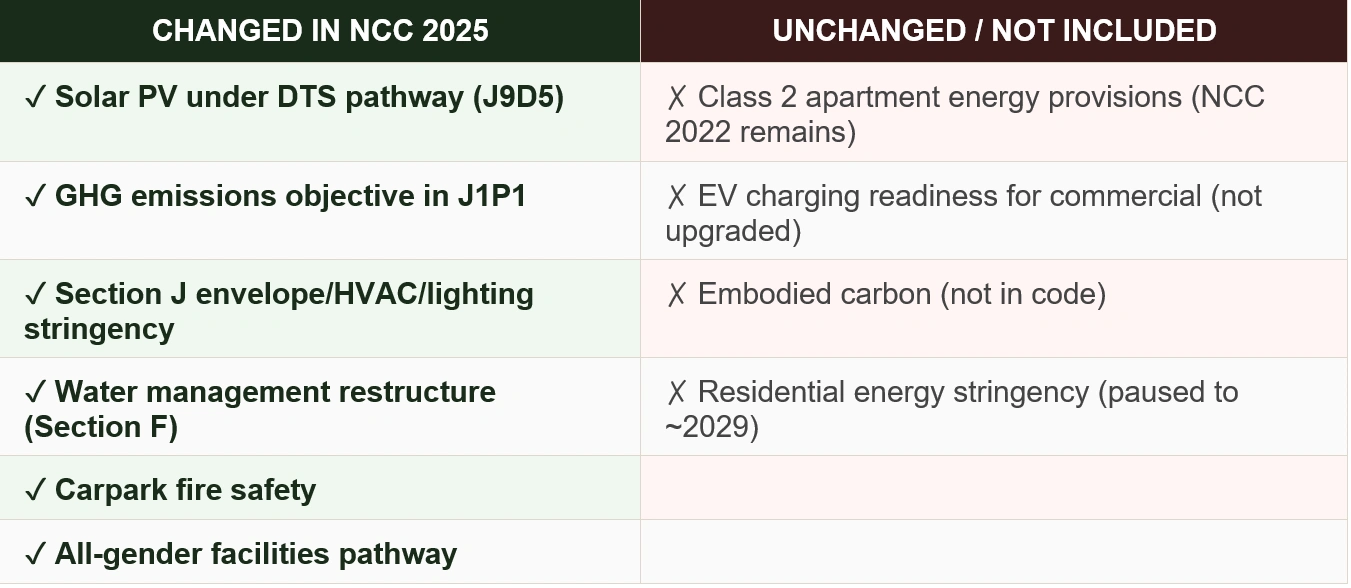
Changed vs Unchanged — Summary
The Design Implications — An Architect's Reading
NCC 2025 Volume One represents a genuine shift in what commercial building design requires. The solar PV requirement changes roof planning from schematic design onward — it is an architectural decision with structural, services coordination and energy compliance consequences, not a services afterthought. The two compliance options (Option A: roof area based; Option B: conditioned floor area based) mean that the right answer is project-specific and requires early energy assessment to determine which produces the smaller system.
The greenhouse gas emissions consideration alongside the energy cap changes the compliance conversation from energy quantity to energy quality. In the ACT, where the grid already carries high renewable content, this makes all-electric services the most straightforward compliance path for new commercial buildings — not because gas is prohibited under NCC 2025, but because the combination of the J9D5b offset requirement and the low ACT grid emission factor makes gas compliance difficult to achieve within available roof space.
The water management restructure will generate the most coordination friction in construction. The membrane-to-substrate requirement under the DTS pathway is a documentation issue before it is a site issue — structural drawings must address slab falls before the concreter is on site. Projects that leave this to site correction will find the Performance Solution alternative adds cost and delays that the design documentation could have avoided entirely.
For mixed-use projects, the split between Class 2 energy provisions (NCC 2022) and Class 5–9 commercial provisions (NCC 2025) requires explicit documentation of which areas of the building are assessed under which regime. Energy assessors and certifiers need this clearly identified from the outset.
Frequently Asked Questions
NCC 2025 commenced in the ACT on 1 May 2026, but it is not mandatory until 1 May 2027. From 1 May 2026, both NCC 2022 and NCC 2025 are available for building approvals—but a project must nominate one version and cannot mix provisions. Projects with a DA or Works Approval lodged before 1 November 2026 can continue under NCC 2022 until that approval expires. Projects seeking building approval after 1 May 2027 must comply with NCC 2025.
The DTS pathway under J9D5 provides two compliance options. Option A requires PV covering the available roof area — net of exclusions, including trafficable zones, plant areas, surfaces shaded for more than 10% of daylight hours, and other specified areas. Option B requires a minimum installed output per m² of conditioned floor area based on building class and climate zone. Practitioners select whichever option results in the smaller system for their specific project. For typical mid-rise commercial buildings, Option A is the practical path and in many cases covers 50–70% of total roof area after exclusions are applied. The 'available roof area' after exclusions is rarely the total roof area.
This is an answer. NCC 2025 does not prohibit gas in commercial buildings. However, the combination of the J9D5b gas offset requirement and the ACT's already-low grid electricity emission factors makes gas compliance difficult to achieve under the DTS pathway for many commercial building types. Buildings retaining gas appliances must install additional solar PV to offset the greenhouse gas emissions from those appliances — and this additional PV frequently exceeds available roof space on top of the base J9D5 requirement. In practice, for most new ACT commercial buildings, all-electric services are the lower-cost and more straightforward DTS compliance path. Gas use can potentially be demonstrated via a Performance Solution, but this requires additional consultant engagement and certifier assessment.
Mixed-use buildings with Class 2 apartments and commercial classes (5–9, Class 6 retail) in the same building are subject to two different energy regimes. The commercial portions must meet NCC 2025 Section J requirements, including the solar PV provision and GHG considerations. The Class 2 apartment portions remain under NCC 2022 Amendment 2 energy provisions. These regimes must be documented separately and cannot be blended. The PV system required for the commercial component cannot be credited against the residential energy performance. Engage your energy assessor and certifier from schematic design to ensure the documentation clearly identifies which areas comply with which regime.
Under the NCC 2025 DTS pathway, waterproofing membranes must be applied to the structural concrete substrate without a screed between the substrate and the membrane. Falls must be achieved in the structural slab. However, where the structural slab cannot achieve compliant falls, a performance solution remains available as an alternative pathway—this requires engagement of a suitably qualified consultant to document the alternative approach and agreement from the certifier. A performance solution adds cost and time relative to designing a compliant system that falls into the structural documentation from the outset. The DTS requirement is a documentation discipline—address it in the structural drawings, not on site.
Shiraz Atelier designs and documents commercial and multi-residential buildings across the ACT. If you are planning a commercial project and want to understand how NCC 2025 affects your specific building type, site and programme, contact us for an early compliance assessment.
— Shiraz Atelier · Building Design Canberra · shirazatelier.com.au