Understanding Canberra's Climate: Why Passive Solar Design Matters for Your Home

SUSTAINABLE & ENERGY EFFICIENT DESIGN · CANBERRA ACT
Canberra has one of Australia's most challenging residential climates — cold winters down to -8°C, hot summers to 41°C, and large daily temperature swings year-round. Passive solar design addresses this by using building orientation, thermal mass, glazing, shading and insulation to capture winter warmth and reject summer heat — without mechanical systems. Well-designed passive solar homes in the ACT use 40–60% less energy for heating and cooling than conventionally built homes.
If you have lived through a Canberra winter, you know the challenge — frosty mornings, cold floors and energy bills that reflect the strain of heating a home against a genuinely demanding climate. Then summer arrives: dry, intense heat that turns a poorly designed home into an oven by mid-afternoon.
This is not a complaint about Canberra. It is a design brief. The city's climate is specific and well-understood — and passive solar design is the architectural response that has been refined to meet it. This article explains the five principles behind that response, and what they mean in practice for a home designed in the ACT.
KEY TAKEAWAYS:
• Canberra's semi-continental climate (winter lows to -8°C, summer highs to 41°C) makes passive solar design essential, not optional
• Well-designed passive solar homes use 40–60% less energy for heating and cooling — saving $720–$1,080+ annually on an average Canberra energy bill
• Five core principles work together: orientation, thermal mass, glazing, shading, and insulation/airtightness
• North-facing living areas with correctly sized eaves admit winter sun and block summer sun using the same fixed architectural elements
• Even challenging blocks — east-west orientation, south-facing slopes, narrow urban lots — can achieve 7–8 star NatHERS ratings with the right design approach
Passive solar principles apply to renovations and extensions, not just new builds
What Makes Canberra's Climate So Challenging for Home Design?
Canberra sits at approximately 570 metres elevation in southeastern Australia — a semi-continental climate with no maritime moderating influence. For residential design, this creates a specific set of conditions that must be addressed from the earliest design stage.
.
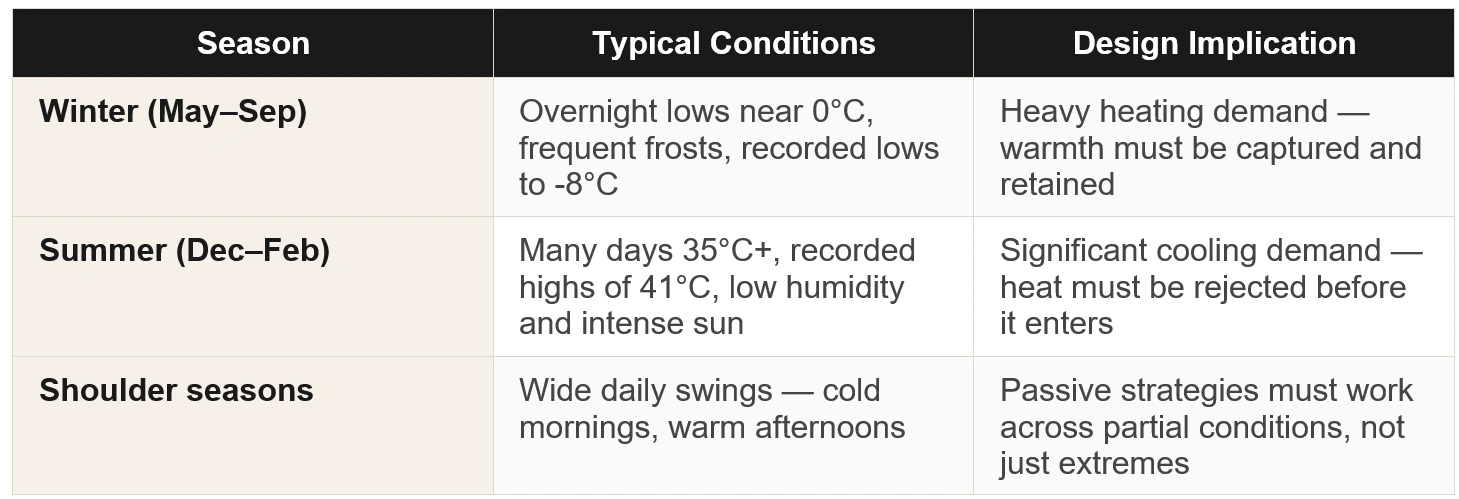
The financial consequence of getting this wrong is substantial. Typical annual electricity bills for a Canberra household range from $1,500 to $2,100, among the highest in Australia, driven primarily by heating. Heating and cooling represent the largest portion of residential energy consumption in the ACT. Passive solar design addresses this at the source, not with a more efficient heater.
What Is Passive Solar Design and How Does It Work?
Passive solar design uses the building itself, its orientation, mass, glazing, and form, to regulate indoor temperature using the sun's energy and natural airflow. Unlike active solar systems (panels, pumps, mechanical equipment), passive design has no moving parts, no operating costs, and no maintenance requirements beyond what any standard building requires.
Five elements work together as a system. Each is individually useful; together they create a home that is naturally comfortable across Canberra's full seasonal range with minimal mechanical intervention.
The analogy that holds: passive solar design is architectural judo. It uses the sun's predictable movement and seasonal intensity to your advantage rather than fighting against it.
1- Orientation
Why Does North-Facing Orientation Matter So Much in Canberra?
In the Southern Hemisphere, the sun tracks across the northern sky throughout the day. Positioning the main living areas to face between 15° west and 20° east of true north is the single most important passive solar decision and costs nothing if made at the design stage.
At Canberra's latitude (35.3°S), the sun's altitude varies dramatically between seasons: 29–33° above the northern horizon at the winter solstice and 65–67° at the summer solstice. This 35+ degree variation is what makes fixed horizontal shading so effective and why orientation is the cornerstone of passive solar performance.
When main living areas face north, the same window that captures winter warmth receives minimal direct summer sun — not through any mechanical adjustment, but through geometry. This is the elegant logic of passive solar design.
What If My Block Doesn't Face North?
Most Canberra blocks can achieve excellent passive solar performance regardless of street orientation. The challenge is greater on some sites — east-west blocks, south-facing slopes, narrow inner-suburb lots — but the strategies that address them are well-established.
• East-west blocks: clerestory windows, skylights, and split-level designs to capture northern light over the roofline
• South-facing slopes: two-story designs with upper-level north-facing glazing above the slope's shadow line
• Narrow urban infill: internal courtyards or light wells creating north-facing zones within a compact footprint
• Hemmed-in sites: high-level windows and reflective surfaces to redirect light into living spaces
We have delivered 7-star and 8-star NatHERS-rated homes across challenging sites in Denman, Throsby, Gungahlin, and Canberra's inner suburbs. The solutions require more considered design thinking, but the performance outcomes are achievable on almost any ACT block.
2-Thermal Mass
What Is Thermal Mass and Why Is It Essential in a Canberra Home?
"Thermal mass" refers to the ability of dense materials, such as concrete, brick, stone, and rammed earth, to absorb, store, and slowly release heat. In a Canberra home, correctly positioned thermal mass charges during sunny winter days and release warmth throughout the cold night, functioning as a silent, cost-free radiant heating system.
The relationship between north-facing glazing and thermal mass is the most critical balance in passive solar design. As a design guideline, north-facing glass should represent approximately 15–25% of the area of exposed thermal mass in a room. For Canberra's cold climate, we typically target the upper end of that range, around 20–25%.
Common Thermal Mass Mistakes That Undermine Performance
• Too much glazing, insufficient mass — daytime overheating and rapid cooling after sunset
• Mass in the wrong position — covered by carpet or rugs, or located away from direct winter sun
• Uninsulated slabs — heat drains into the ground rather than being stored and released into the room
• Slab without edge insulation — a common ACT construction problem that allows captured heat to escape at the perimeter
For Canberra projects we typically specify polished concrete slabs in north-facing living areas, internal brick or masonry walls positioned to receive winter sunlight, and dark or mid-toned surface finishes to maximise solar absorption. The mass must be thermally isolated from the ground beneath and exposed on both surfaces — to the sun for charging and to the room air for heat distribution.
3- Glazing
How Should Windows Be Designed for Passive Solar Performance in the ACT?
Windows are simultaneously the thermal weak point and the solar gain opportunity in any building envelope. Up to 40% of a home's heating energy can be lost through glazing; up to 87% of unwanted summer heat gain enters through it. The design response is different for each orientation.
Modern high-performance glazing has transformed what is achievable in passive solar design. Double-glazed units with argon gas fills and low-E coatings achieve thermal resistance values approaching R0.6–R0.8 while still transmitting 60–70% of visible light. The upfront cost premium of $150–$250 per square metre above standard glazing typically pays back within five to eight years through reduced heating and cooling costs in Canberra's climate.