How to Design a Custom Home in Canberra: What You Need to Know Before You Start
The short answer: a custom home design process starts with your site — its orientation, slope and planning controls — not with a floor plan. Get those conditions right first and every design decision that follows becomes clearer, faster and less expensive to resolve.
How to Design a Custom Home in Canberra: What You Need to Know Before You Start
Category: Custom Homes · Written by Roy · ~1,100 words · 8 min read
Planning a custom home in Canberra is one of the most significant decisions most people will make — and one of the least understood. There is a common assumption that custom design means expensive, slow, and complicated. In practice, a well-structured custom design process is how you avoid those things, not how you invite them.
This article explains what custom home design actually involves, what shapes the outcome, and what to understand before you begin. Whether you own a block in Whitlam, are considering a knockdown rebuild in Narrabundah, or are still at the early planning stage, the fundamentals are the same.
What 'Custom Home Design' Actually Means
A custom home is not the opposite of affordable. It is the opposite of generic. It means your home is designed specifically for your block, your lifestyle and your long-term goals — not adapted from a standard floor plan that was designed for a different site, a different family and a different set of priorities.
The design process translates your brief — your needs, your preferences, your site — into documentation that a builder can construct. That documentation includes floor plans, elevations, sections, and the detail needed for accurate pricing and approval submissions.
A building designer is not an architect in the legal sense, but in practical terms the design work overlaps significantly for residential projects. The key difference is cost structure and focus — building designers tend to be more accessible for residential budgets and more focused on buildable outcomes than on award-winning aesthetics.
The Five Things That Shape Every Custom Home Design
Whatever your vision for your home, five things will shape what is actually achievable — and understanding them early is what separates a smooth design process from a frustrating one.
1. Your Site
The block itself is the starting point for everything. Its dimensions, orientation, slope, neighbouring context and street frontage all influence what layouts are possible and what design decisions will need to be made. A 450m² block in Taylor with a 2-metre cross fall is a completely different design problem to a 600m² flat block in Kaleen — even if the brief is the same.
2. Solar Orientation
Canberra's climate — cold winters, hot summers, wide daily temperature swings — makes solar orientation one of the most important design decisions in any ACT home. Getting main living areas facing north, and minimising east and west-facing glass, is how you build a home that is warm in winter without excessive heating costs. This decision is made in the earliest stages of design and cannot be easily corrected later.
3. Your Lifestyle
How you actually live — how many people, what routines, what future needs, how you use indoor and outdoor space — should drive the spatial decisions in your home. A designer who asks these questions in depth before drawing anything will produce a better outcome than one who shows you a floor plan in the first meeting.
4. Planning Controls
Every block in Canberra sits within a planning zone that sets limits on what can be built — site coverage, setbacks, height, and in some cases, materials and finishes. These controls are not obstacles; they are the parameters within which good design happens. Understanding them early prevents wasted design work.
5. Budget Clarity
A custom home design that cannot be built within your budget is not a design — it is an expensive drawing. Realistic budget clarity from the outset allows design decisions to be made with construction feasibility in mind, not retrofitted to a budget after the fact.
What Are the Most Common Mistakes Homeowners Make Before Starting a Custom Home?
A structured custom home design process moves through clear stages — each with defined outcomes and decision points.
• Initial Consultation & Feasibility Review
The first stage is about understanding your site, your brief and your constraints. A good designer will review your block conditions, relevant planning controls and preliminary budget before any design work begins. The output is a clear sense of what is achievable and a staged plan for the project.
• Concept Design Development
The concept stage translates your brief into preliminary floor plans, spatial zoning and an orientation strategy. This is where the big decisions are made — room layout, indoor-outdoor connection, entry sequence, the relationship between public and private zones. Feedback at this stage is what shapes everything that follows.
• Planning & Approval Documentation
Where a development application or building approval is required, documentation is prepared and submitted to the relevant ACT authority. Your designer coordinates with structural, energy and other consultants as required.
• Detailed Construction Documentation
Once the design is approved, detailed drawings are prepared for construction — dimensioned plans, sections, elevations, schedules and specifications. This is the documentation your builder uses to price and construct your home.
• Construction Phase Support
During construction, your designer should be available to clarify documentation, respond to builder queries and manage any design adjustments that arise on site.
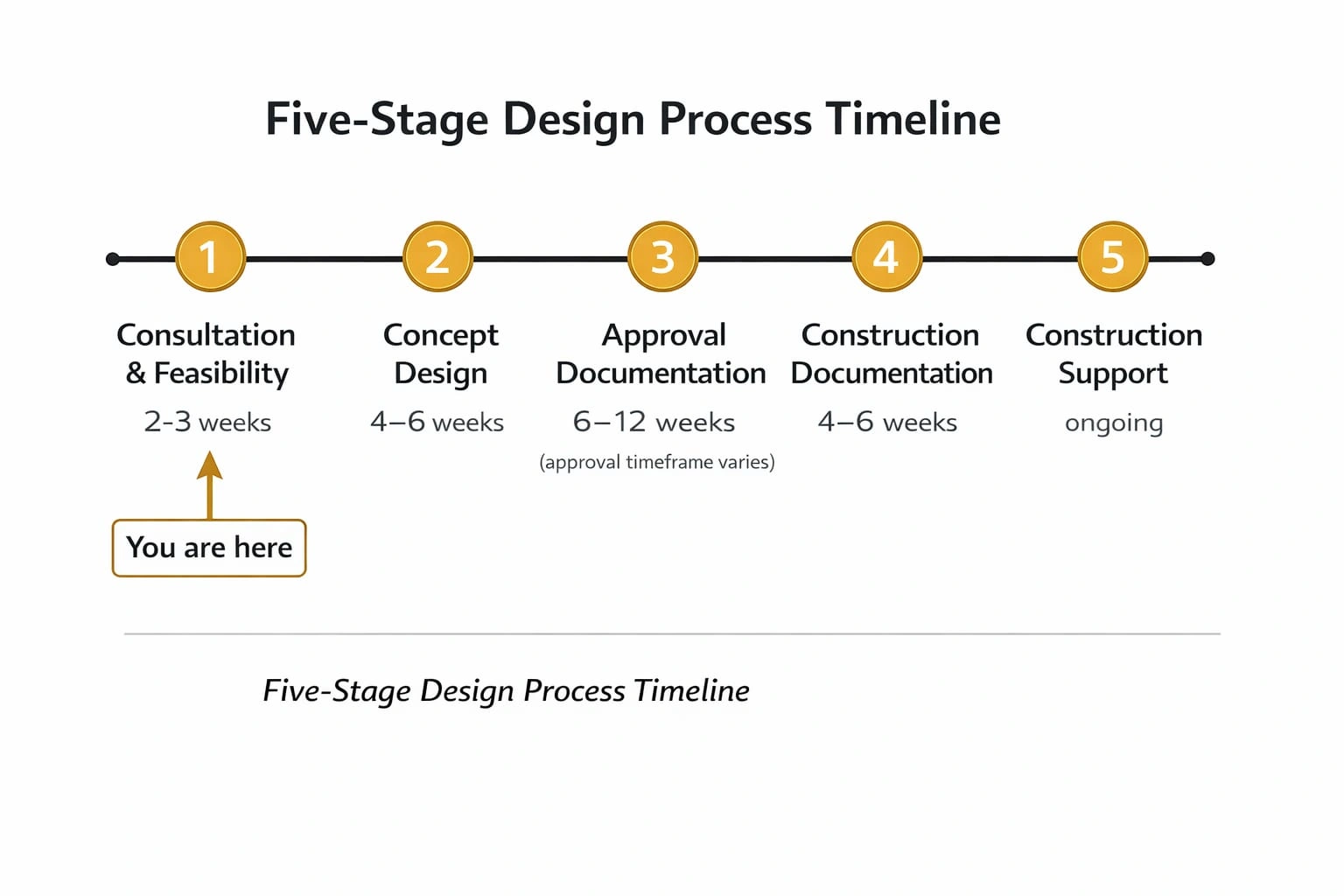
Five-Stage Design Process Timeline
What Are the Most Common Mistakes Homeowners Make Before Starting a Custom Home?
With more than 70 years of combined experience, our team has seen the same mistakes repeated — and they are almost always avoidable.
• Choosing a builder before finalising the design. Builders price what they are given. If documentation is incomplete or unclear, the price will reflect that uncertainty — either through inflated contingencies or through variations once work is underway.
• Letting inspiration boards drive the brief. Knowing what you want a home to feel like is valuable. But a Pinterest board is not a brief. A good designer will help you translate aesthetic preferences into spatial decisions.
• Underestimating the value of site analysis. The block conditions shape every design decision. Skipping a proper site analysis at the start is how you end up with a design that fights its site rather than responds to it.
• Treating approval as the designer's problem. Approvals involve your site, your project and your timeline. Understanding the approval pathway — what is required, how long it takes, what can speed it up — is part of being an informed client.
None of these mistakes are the result of clients being uninformed. They are the result of a design process that does not explain itself clearly enough. A good designer removes that ambiguity from the start.
Frequently Asked Questions About Custom Home Design in Canberra
The design process typically takes between four and eight months from initial consultation to construction documentation, depending on project scope and approval pathway. Simple projects on straightforward sites can move faster; more complex sites or those requiring merit assessment will take longer. We provide a clear indicative timeline at the start of every project.
For most residential projects in the ACT — including custom homes, renovations, dual occupancies and knockdown rebuilds — a building designer can provide equivalent design and documentation services to an architect. Building designers are registered and regulated, work within the same planning and construction code framework, and typically offer more accessible fee structures for residential budgets.
Design fees for a custom home in the ACT vary depending on project scope, site complexity and the range of services required — from early feasibility through to full construction documentation. We provide a clear, staged fee proposal at the outset so you understand exactly what each stage costs and what it produces.
Yes. Our team includes a PhD candidate specialising in energy-efficient design with strong knowledge of Passive House principles, passive solar design and zero-energy strategies. Canberra's climate responds particularly well to these approaches — and the best time to integrate them is at the concept design stage, not as a retrofit. We can apply this thinking at any level of detail your project requires.
Most new custom homes in the ACT require a development application (DA) followed by a building approval (BA). Some straightforward builds on code-compliant sites may qualify for a building approval only. The applicable pathway depends on your block's planning zone, the proposed design's compliance with the Territory Plan, and any site-specific conditions. We advise on the correct pathway at the feasibility stage.
We have designed custom homes across Canberra's districts including Belconnen, East Canberra, Gungahlin, Inner North and City, Inner South, Molonglo Valley, Tuggeranong, Weston Creek, and Woden. Each suburb presents different site conditions, planning controls and neighbourhood context — and we treat every block as a unique design problem.
Planning a custom home in Canberra — whether on a new block in Throsby, an infill site in Deakin or a knockdown rebuild in Red Hill — is a process that rewards preparation. The more clearly you understand your site, your brief and your constraints before design begins, the better the outcome will be.
At Shiraz Atelier,
We guide every custom home project through a clear, structured process—from early site review and feasibility through to construction documentation and build support. If you are at the planning stage, the best first step is a conversation about your site.